



Table of Contents:
- Introduction
- What’s Changing in Mobile App User Experience in 2026?
- Mobile App User Experience Guidelines That Every Brand Needs in 2026
- Advanced Design Upgrades for Mobile UX in 2026
- How Industry Leaders Are Upgrading Mobile UX
- “2026 UX Benchmark Data” Table (even estimated)
- 2026 Mobile App UX Audit Framework (Checklist)
- Future-Proof Your Mobile Experience Now
- FAQs on How to Improve Mobile App User Experience in 2026
Mobile apps are part of our daily lives, which means users want them to be smooth, efficient, and effortless. But with the upgrading of devices, new technologies, and changing habits, there is a huge need to improve mobile app user experience. With so many options available, “80% of users decide whether to keep an app or not within the first 24 hours, 70-75% of users don’t come back, and only about 25-30% of users return after the first day.”
This is the reason businesses need updated mobile app user experience guidelines to keep their customers happy and intact. Yellow Slice has made a shift towards the trending UI/UX scenario with mobile app user experience testing that helps brands to make their apps faster, easier, and more enjoyable to use.
What’s Changing in Mobile App User Experience in 2026?
Mobile app user experience is going through many changes because of AI and many smart technologies in the field of UI/UX. Many personalization features have come into practice due to AI. Voice & touch systems have blended together, which makes navigation accessible. Wearable and foldable devices have also evolved with time, which helps brands to uplift their layouts according to different shapes and contexts.
Why are standard UX rules becoming obsolete and new guidelines matter?
Standard UX is becoming obsolete as the way people are using their apps is changing very fast. Old UI/UX designs can no longer give them the benefit that new and updated mobile app user experiences can give. Traditional layouts and navigation panels cannot fulfill the people’s expectations nowadays. Thus, the latest mobile app user experience guidelines are necessary to meet the demands.
Mobile App User Experience Guidelines That Every Brand Needs in 2026
The future of mobile UX is all about giving advanced applications to the users. Businesses need to adapt these new guidelines to stay relevant among the users and meet their needs. Here are the key mobile app user experience guidelines every brand needs to follow in 2026.
- Multiple Input Methods: Instead of touch and voice commands, apps in 2026 will be much more. Users will be able to interact through hand gestures and camera recognition. Apps will automatically switch to the most convenient methods that users want based on their search and situations.
- On-device AI: It means AI can directly run on mobile devices without sending data to the servers. Users will be able to get faster results, and apps will be smarter and more advanced, which makes the user’s experience comfortable and soothing with personalization approaches.
- Predictive UX: Apps will be able to predict what users want to do next, like suggesting shortcuts or providing content at the right moment that they are thinking of or want to get details of. This will avoid unnecessary steps and save the time of the users with their tasks.
- Smarter user testing: User testing will be accurate because of advanced technologies. With tracking their expressions, their emotional responses and their movements, they can make layouts accordingly. Brands can get the exact clarity of users getting frustrated or unhappy with which features.
- Continuous UX testing: Mobile app user experience testing will not only be done before the launch; this process will remain continuous. With the whole development process, it will be continued with testing and can be termed as UXops. (UX + DevOps = UXOps).
- Adaptive Layouts: Apps will be able to adjust their layouts according to the devices, like foldable phones, dual screens, and wearables. To create useful experiences for the users, screens will be able to rotate, split, and expand instantly.
- Practical AR: AR refers to “augmented reality,” which means people will be able to try the products before buying and can learn the tasks step-by-step. It will not remain only a feature in upcoming times; it will help in engaging practically in the real world.
- Speed & Performance: Unlike now, slow screens, unclear quality, and long loading times led to uninstalling of the apps. Thus, speed and performance will be the core part of the UX in upcoming times, when people will expect apps to respond in 2-3 seconds.
- Privacy-driven designs: Users want their data to be controlled by themselves. It is mandatory that apps must take clear permissions before using the data. The privacy must remain intact with clear and transparent explanations about every single step that is unknown. It helps in building trust with the customers.
- Digital well-being: Apps will be designed in a way that will reduce distractions, such as composed interfaces and minimum notifications. Even low-battery interfaces will be helpful in completing your work effortlessly.
| “Mobile UX is shifting from a reactive to a predictive approach, which gives users what they need before they ask.” |
Advanced Design Upgrades for Mobile UX in 2026
In 2026, mobile app user experience will turn into more reliable, natural, and responsive mobile app designs, which make users feel at ease. From adjusting layouts to controlling the content as per the user, everything will be more convenient and friendly.
There will be better animations, which are not just to decorate the interfaces but will also be used to guide the user in every step to avoid confusion and wrong accessibility. Animations are designed to work smoothly on all devices to make interaction with the layout better. Removal of decluttered material to maintain the aesthetics and readability of the interface with the help of mobile app user experience guidelines.
This will focus on the important things that matter, which is useful for the users. They can also use multiple screens with seamless shifting from one to another without any interruptions. Therefore, UI/UX designs in 2026 are becoming more flexible, which will help brands to update their layout according to the users’ needs.
How Industry Leaders Are Upgrading Mobile UX
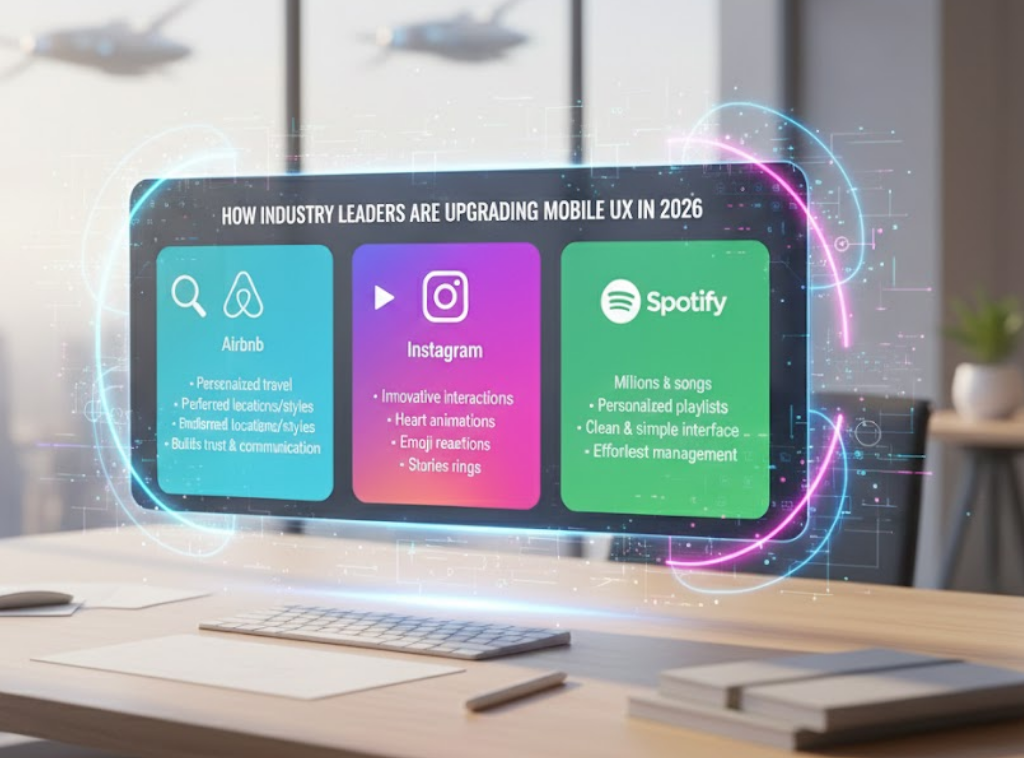
Industries are already upgrading their mobile app user experience to meet 2026 expectations. Many of them are adopting a predictive approach, which means they will be able to understand user habits and provide them with those things before the user asks. There are case studies of some apps upgrading with time.
- Airbnb: They improved user engagement by making the app personal for every user. By reviewing their earlier interactions, like preferred locations or travel styles, they provide them with similar types of information without being asked for by knowing their tastes. With their clear communication and reviewing people’s concerns, they help users to build trust in them.
- Instagram: They always keep in touch with their users. To make their use of time innovative and interactive, they always came up with unique ideas like heart animation when someone likes a post or reel, emoji reactions in stories, a colorful ring around the profile picture when uploading a new story, etc. These changes make the app enjoyable and meaningful.
- Spotify: While offering millions of songs in many different languages, their interface is also clean and simple. With many different playlists like recents, big hits, top 50 playlists, or separate albums by all artists, it prioritizes your choice, preferences, and likings. They make everything manageable effortlessly, and you can listen to your favorite songs without any hassle.
Yellow Slice helps businesses to stay updated with recent and future trends to make their layouts and interfaces user-friendly. With our future-ready and human-centric designs, we are able to predict the users’ needs. We help brands to endorse their products with the latest trends, and our impact-focused designs tend to get purpose-driven results. With our STEP approach and mobile app user experience guidelines, we build interfaces that feel natural, simple, and personalized.
Our Case Insights
People are finding it very complex, as they want the website in a clear and engaging way. Yellow Slice came up with a structured UI layout, which makes their experience organized with visual hierarchy and clear navigation. They focus on simplicity that gained the attention of the users. Its polished UI design is suitable for an acting education platform.
There are many features in the app that people are feeling cluttered and disorganized using. To keep users motivated, it is important to make the interface organized. Yellow Slice is making clean, modular UI screens, positive visuals, clear menus, and navigation patterns. It feels modern and approachable.
Both beginners and active traders use the app. They find it complex, as its usability is difficult. Yellow Slice’s redesign uses well-structured screens to separate major sections like market overview, stocks, and actions (buy/sell). Spacing and icons help users quickly understand where to focus. The updated screens improved user experience for managing stock information and trading tasks more comfortably. |
“2026 UX Benchmark Data” Table (even estimated)
| Headings | Description |
| AI being predictive | AI is becoming the most important part of UI/UX designs. Over 62% of UX designers globally are using AI tools in their daily work. Being predictive, it will only make users’ lives peaceful and simple with personalized layouts and understanding all their needs. |
| Retention of apps | Many apps are installed and uninstalled every day. It is very difficult to keep users on your app for a very long time. As for mobile apps, the retention rate is 6%. Among this, 6% for the Android users and 3-8% for the iOS users. |
| Mobile Supremacy | Mobile phones are dominating the market of design. As 60-62% of the web traffic comes from mobile devices. This simply means brands need to put more focus on mobile-led layouts so that they can make mobile app user experiences the best for the users. |
| Good UX designs | It is mandatory for the brands and companies to maintain good UI/UX designs to be in the race of success. Your interface is the medium to make your brand a renowned brand or an easy close-up. |
| Top trends | Shifting from searching to predicting what you think and what you want. Everything becomes effortless when AI adds spice to the UI/UX field. Emotion-aware interfaces, distraction-free designs, and strong layouts help you to stand out among others. |
| Speedy and secure | Users always want the apps to be fast. As human nature is a little impatient, when they run out of time or meet a deadline, they always want instant loading. They want their data to be safe and secure to avoid any mishap. |
2026 Mobile App UX Audit Framework (Checklist)
- UI performance audit
- Predictive usability audit
- Accessibility score sheet
- UX testing pipeline summary
Future-Proof Your Mobile Experience Now
Mobile app user experience is improving because of mobile app user experience testing. With their new input methods and other relevant changes, everything is evolving very fast. Strong mobile app user experience guidelines not only increase the usability of the apps but also give the best experience, which users expect. A smooth and future-ready app is always the one that keeps them engaged and does not end with uninstalling or deleting it. If you want to upgrade your mobile UX for 2026 and beyond, Yellow Slice can help.
FAQs on How to Improve Mobile App User Experience in 2026
1. Which are essential mobile app user experience guidelines for 2026?
Mobile app user experience guidelines in 2026 will have many features like AI personalization, predictive analytics, AR/VR included, safe and secure data, etc.
2. How is mobile app user experience testing evolving?
Mobile app user experience testing is evolving at a high pace, such as voice and expression testing, biometrics, cloud testing, identifying flaws with AI, and so on.
3 . How can mobile app user experience be improved?
It can be improved when AI comes into practice to benefit people in every instance. From thinking to getting accurate results, mobile app user experience can be improved with the integration of the latest technologies.